Job counts and pay in this guide come from the live listings on this site as of October 24, 2026. They change daily; the linked pages always show today’s numbers.
You have a micro1 listing open and the next step is an AI interview. It asks about your experience and, for technical roles, tests the skill itself. We joined micro1 and went through the screening so you know what is coming. Some applicants call the AI recruiter Zara, we will just say "the AI recruiter" here.
TL;DR
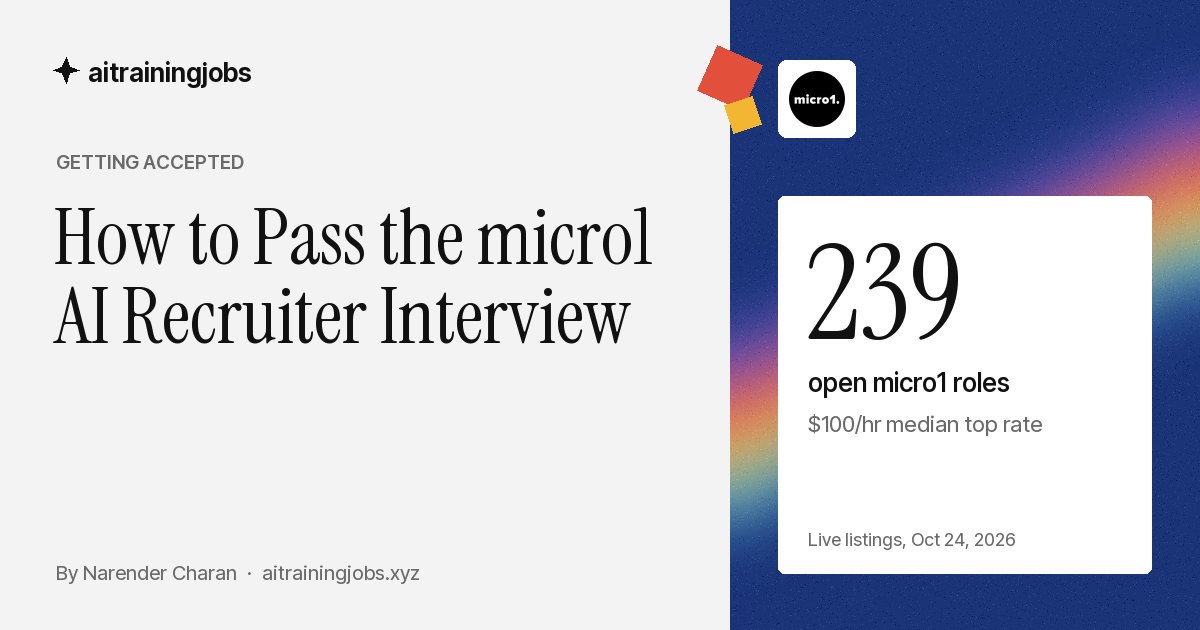
- micro1 has 239 open listings as of October 24, 2026, with a median top rate of $100/hr.
- The micro1 AI interview asks about your experience and, for technical roles, tests the skill live. Nothing exotic, but vague answers cost you.
- Generalist "Evaluation Specialist" roles are the most open entry point: 51 micro1 listings need no degree or specialist experience.
- Do it somewhere quiet, with a working camera and mic.
- Passing puts you in the pool for a project match. It is not an offer and not guaranteed work.
Getting through the micro1 AI recruiter interview comes down to three things: a listing that fits your background, a room where the camera and mic work, and answers that name work you have actually done.
What micro1 is screening for
micro1 recruits contractors for AI data work through an AI recruiter interview. It posts a wide range, from generalist evaluation roles that welcome recent graduates to specialist roles in medicine, finance, engineering and research.
As of October 24, 2026, we list 239 open micro1 roles. The median top rate is $100/hr, the 10th percentile top rate is $30/hr and the 90th is $300/hr. Most listings state a top rate only, so read every figure as "up to". Five micro1 listings state no pay at all; the rate is given during onboarding.
| micro1 listings, as of October 24, 2026 | Figure |
|---|---|
| Open listings | 239 |
| Median top hourly rate | $100/hr |
| 10th percentile top rate | $30/hr |
| 90th percentile top rate | $300/hr |
| Highest top rate | $400/hr |
| Listings with no stated pay | 5 |
| Beginner-friendly | 51 |
| Say worldwide | 28 |
| Name specific countries | 51 |
| Say only "Remote" | 160 |
By field, Generalist leads with 52 listings, then Law & compliance 39, Medicine & health 32, Software & data 29, Science & engineering 23, Voice & audio 22, Finance & business 20 and Design & creative 7.
Eligibility needs a careful read. Only 28 micro1 listings say worldwide. Another 51 name specific countries, and 160 say only "Remote", which does not tell you where you can apply from. Check the country field before you spend an hour on an application. We vetted micro1 the same way we vet every platform we list, and you can read how we vet platforms if you want the process.
How the micro1 AI interview works, step by step
Our notes on micro1 are short, and we will stick to them rather than guess at the parts we did not see.
Step 1: Apply on the listing page
Pick a listing and apply from its page. There is no separate sign-up funnel to chase. The listing you choose shapes the interview, so the choice matters more than most people expect. A generalist role and an attorney role lead to very different conversations.
Step 2: Complete the AI recruiter interview
The interview asks about your experience. For technical roles, it also tests the skill itself. That means the format varies by project: a generalist might talk through background and judgement, while a specialist should expect to demonstrate the work. Length, questions and any retake policy vary by project, so we cannot tell you what yours will contain.
Set yourself up properly. Quiet room, working camera, working mic. The interviewer is reading how you communicate as much as what you say.
Step 3: Wait for a project match
If you pass, micro1 matches you to a project when one opens. That is the whole of it. There is no queue position you can check, and no date we can give you. A pass is a door opening, not a start date.
Common reasons people get rejected
We have no data on acceptance rates, and we will not pretend otherwise. What follows is advice drawn from how the interview is structured.
| Mistake | Why it hurts | Do this instead |
|---|---|---|
| Answering in generalities | The interview is scoring whether your experience maps to the role | Name the field, the task and what you produced |
| Treating a technical portion as trivia | For technical roles the interview tests the skill itself | Practise the actual skill before you start, out loud or on screen |
| Taking the call in a noisy room | Camera and mic quality shape how your answers land | Book a quiet hour and test both first |
| Applying to a specialist role without the background | Those listings assume domain depth | Start with a Generalist Evaluation Specialist listing |
| Assuming "Remote" means anywhere | Only 28 micro1 listings say worldwide | Read the country field on each listing |
| Treating a pass as a job offer | Passing puts you in the pool for a match | Keep applying elsewhere while you wait |
How to prepare
Set up before you think about answers
Camera, mic, lighting, a closed door. Test the camera and mic in the same room you will use. Have your CV open on a second screen so dates and titles are exact. The AI recruiter asks about experience, and small factual slips are easy to avoid.
Choose the listing that fits
Generalist roles are the widest door. We track generalist AI training jobs separately, and 51 of the micro1 listings need no degree or specialist experience.
If you do have a specialty, use it. The law and compliance AI training roles on micro1 pay at the top of the range, and the listings are specific about what they want. A few live examples:
- Investment Funds & Asset Management Attorney, $140 to $400/hr, location not stated.
- Structured Finance Attorney, $140 to $400/hr, location not stated.
Those rates are top rates on the listings. Read them as "up to". Pay across fields is not one market, and a generalist rate tells you nothing about what an attorney role pays or the reverse.
Answer with specifics
Prepare three or four short stories from your own work: what the task was, what you did, what came out of it. Rehearse them out loud once. When the interview tests a skill live, walk through your reasoning rather than jumping to an answer. The same pattern runs through our guide to the Mercor AI interview, which is worth reading if you are applying in parallel.
What happens after you pass
You go into the pool. Projects start and they end, and a match happens when a project opens that fits your profile. Passing the interview does not guarantee tasks, hours or earnings. Nobody can promise you a set amount, and we will not.
Keep other applications moving while you wait. We list 1,669 open roles across the 14 platforms we have joined, and you can browse all open AI training jobs at any time. There is no cost to having several applications in flight at once.
If it doesn't work out
micro1 is not the only platform doing this work, and the fit depends on your field.
For subject-matter and language roles, SME Careers jobs and screening is worth a look. It is where SuperAnnotate hires experts for AI training projects, it names eligible countries on almost every role, and many roles are open across South and Southeast Asia as well as the US and Europe. Expect a skills assessment in your subject or language.
For medicine, law, finance and science work, AfterQuery jobs and screening covers the same territory with a screening task that looks like the real work. Listings there refresh weekly, so a role can close between refreshes.
If your background is health rather than law, start from medicine and health AI training jobs. If you are weighing several platforms at once, platforms compared side by side sets out what each one screens for.
Two other guides fit specific skills. How to Pass the Babel Audio Test covers transcription, voice acting and conversation partner work. How to Pass Mindrift's Qualification Tests covers writers, editors and experts. For a wider sweep, see DataAnnotation alternatives that are hiring now and platforms like Outlier to earn money training AI.
One note on tax and visas: whether you can take contract work, and how it is taxed, depends on where you live. Check locally.
Where to go from here
Start with micro1 jobs and screening for the full picture of how the platform works, then pick a listing that matches your background before you sit the interview. If you are still deciding whether micro1 is the right first application, the generalist listings are the least demanding place to begin.
Questions people ask
- What does the micro1 AI interview ask?
- The micro1 AI recruiter interview asks about your experience, and for technical roles it also tests the skill itself. Format, length, questions and retake rules vary by project, so we cannot say exactly what yours will contain.
- Does passing the micro1 AI interview mean I am hired?
- Passing the micro1 AI recruiter interview puts you in the pool for a project match, not an offer or guaranteed work. Projects start when one opens that fits your profile, and passing does not guarantee tasks, hours or earnings.
- What should I prepare before a micro1 AI interview?
- We recommend a quiet room with a working camera and mic, plus your CV open so dates and titles are exact. Prepare three or four short stories from your own work covering the task, what you did and what came out of it.
- Are micro1 AI interviews live skill tests?
- For technical roles, the micro1 AI interview tests the skill itself, so expect to demonstrate the work rather than only discuss your background. Generalist roles may focus more on your experience and judgement.
Written by
Founder, AI Training Jobs and RemoteStack
Narender runs AI Training Jobs and RemoteStack. Before a platform is listed here, he joins it and goes through its real application: the profile, the AI interview or skills test, and onboarding.
About Narender · How we vet platforms · How we make money · LinkedIn